
 Google Scholar
Spiking Neural Networks for Low-Power Vibration-Based Predictive Maintenance
ICONS 2025
A Vasilache, S Nitzsche, C Kneidl, M Tekneyan, M Neher, J Becker
The approach involes integrating spiking neurons into recurrent neural architectures, applied to the industrial domain of Predictive Maintenance.
Use Case
The methodology was applied to a vibration-based monitoring system for a Progressing Cavity Pump (PCP). The pump’s eccentric and rotating motion creates specific vibration patterns that reflect its operational state. To detect deviations from normal operation, we developed a model that could identify impermissible conditions including overpressure (exceeding 12 bar discharge pressure) and cavitation (suction pressure below 0.75 bar).

Data Preprocessing and Spike Encoding
The preprocessing pipeline, illustrated below, converted raw accelerometer data into spike trains.
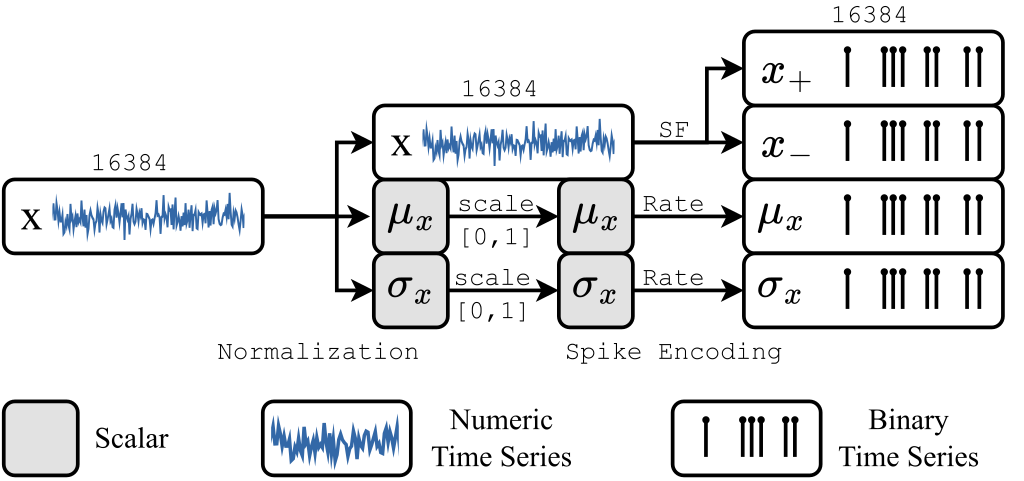
Preprocessing pipeline applied to each accelerometer axis. After global standardization, local normalization produces a normalized time series and extracts local statistics. These components are converted to spike trains using distinct encoding methods: Step-Forward encoding for the time series and Poisson rate encoding for the statistical features.
- Standardization: Raw data was normalized using global mean and standard deviation. Local statistics (mean and standard deviation) were extracted from each time window to capture segment-specific characteristics and later encoded as additional features.
- Spike Encoding: The normalized signal was encoded using the Step-Forward algorithm, and the local statistics were encoded using Poisson rate encoding, with scalar values normalized to [0,1] and then rate-encoded over the time window.
Recurrent SNN Architecture
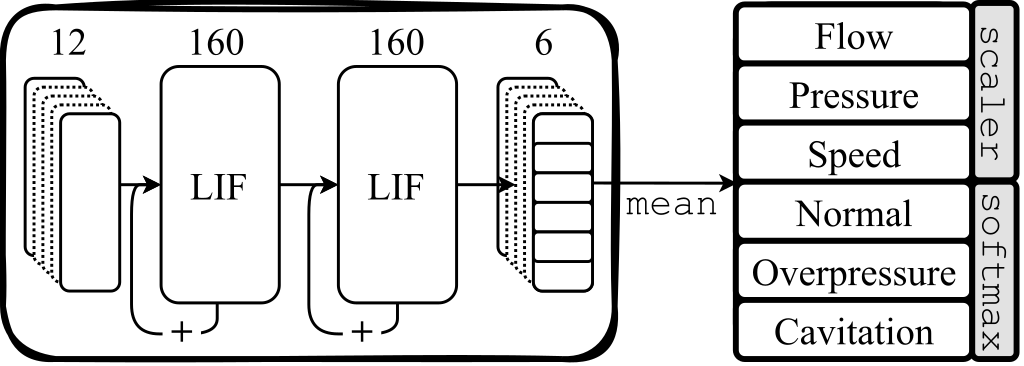
The network architecture, shown below, employed a recurrent SNN and performed simultaneous regression and classification.
Energy Consumption Analysis
The model was developed for energy efficiency, achieved through activation and connection sparsity, without explicit regularization.
Activation Sparsity: The model’s neurons fire in only 9.75% of timesteps. This results in an activation sparsity of 90.25%, which reduces computation on a neuromorphic platform.
Connection Sparsity: Achieved with pruning, leading to a 32.82% connection sparsity.
Energy usage was estimated across different hardware platforms:
| Device | Energy (J) | ||
|---|---|---|---|
| Total | Synaptic | Neuron | |
| x86 | 1.13 × 101 | 1.12 × 101 | 4.59 × 10⁻² |
| ARM | 1.18 × 100 | 1.17 × 100 | 4.81 × 10⁻³ |
| Loihi | (3.16 ± 0.33) × 10-3 | (2.73 ± 0.33) × 10-3 | 4.33 × 10⁻⁴ |
- When running on a neuromorphic chip (Loihi), the estimated energy consumption was 3.16 mJ per inference.
- This efficiency is a result of:
- Software-level sparsity (~15x gain): From the combined effect of activation and connection sparsity.
- Hardware efficiency: The Loihi platform is approximately ~300x more energy-efficient for synaptic operations than a standard x86 CPU.
- Together, these software and hardware optimizations produce an estimated 4100x reduction in synaptic energy compared to an x86 processor.
When combining software-level optimizations like sparsity with specialized neuromorphic hardware,such a co-design approach can create highly efficient on-device AI.