
 Google Scholar
Training Neural Networks by Optimizing Neuron Positions
LIVING MACHINES 2025
L Erb, T Boccato, A Vasilache, J Becker, N Toschi
We introduce a parameter-efficient approach where neurons are embedded within Euclidean space and their spatial positions are optimized during training. The neurons are organized into layers by constraining their z-coordinates, as illustrated in the figure below, and a regularization term prevents the layers from collapsing. By using distance-dependent wiring rules, we reduce the training parameter complexity from \(\mathcal{O}(n^2)\) to \(\mathcal{O}(n)\).
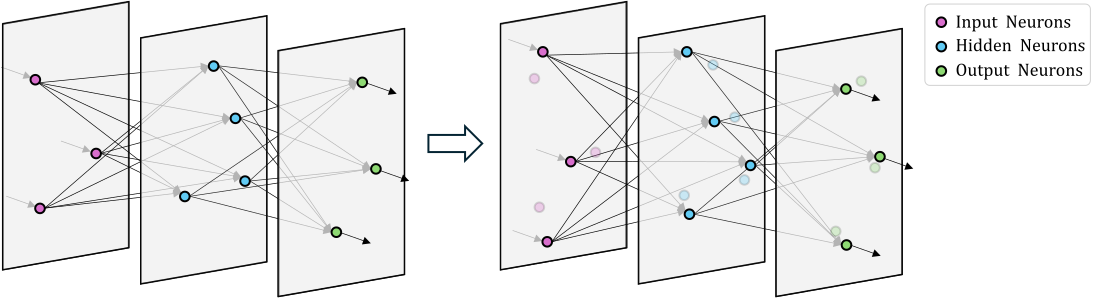
Illustration of a three-layer feedforward network embedded in three-dimensional Euclidean space. Neurons optimize their positions within their respective two-dimensional layers while maintaining fixed z-coordinates corresponding to their layer indices.
Spatial Neuron Embedding
In this framework, each neuron \(i\) is assigned a position \(\mathbf{p}_{i}= (x_{i} , y_{i}, z_{i}) \in \mathbb{R}^{3}\) in three-dimensional Euclidean space. The connection weight between any two neurons \(i\) and \(j\) is computed as a differentiable function of their spatial distance:
\[w_{ij}= \frac{1}{\|\mathbf{p}_{i}- \mathbf{p}_{j}\|_{2}}\]This formulation is inspired by the inverse relationship between conductance \(G\) and length \(L\) in electrical circuits:
\[G = \frac{A}{\rho \cdot L}\]where \(A\) represents the cross-sectional area and \(\rho\) is the resistivity of the material. This biological analogy reflects how synaptic strength in neural systems often decreases with increasing physical distance between neurons.